
Words Like Honey
The Words We Use With Children

Jesus, Justice & Joash is based on the work of Rev. Joash P. Thomas - global human rights advocate, international speaker, and public theologian. Joash’s newly released book, The Justice of Jesus is available here or wherever you buy your books. Do leave a review on Amazon and Goodreads after reading this book to make it easy for others to find it too. Anyone in the US ordering via Baker Book House gets the book for 30% off + free shipping! This is the perfect New Year’s gift for that family member or friend who says to you, “Justice isn’t Christian; it’s woke Marxism.”
Words have the power to shape us, form us, and transform us - even more so for children.
Something my bishop (Chris EW Green) often reminds our diocese clergy of is to see children as much as full members of the Church. While I’m personally not a parent, I will be a spiritual father to children (and adults) in the Church when I’m ordained into the priesthood as ‘Father Joash’ on February 1.
I have a ton of respect for dear friends who carefully parent their children in healthy, Jesus-shaped, justice-oriented ways - despite their own childhood religious trauma. Perhaps you yourself are someone who is looking for helpful resources to intentionally parent your children in ways that nurture wholeness in them - so that they can be beacons of wholeness in our divided world today. Or maybe you have children in your life you want to embody Christ to in intentional ways as they have their own spiritual journeys.
Amy Hughes has written a helpful book called Words Like Honey: How to Avoid Unintentional Harm, Model Kindness, and Nurture Your Child’s Faith Through What You Say. You can purchase this book here (US only) or wherever you buy your books!
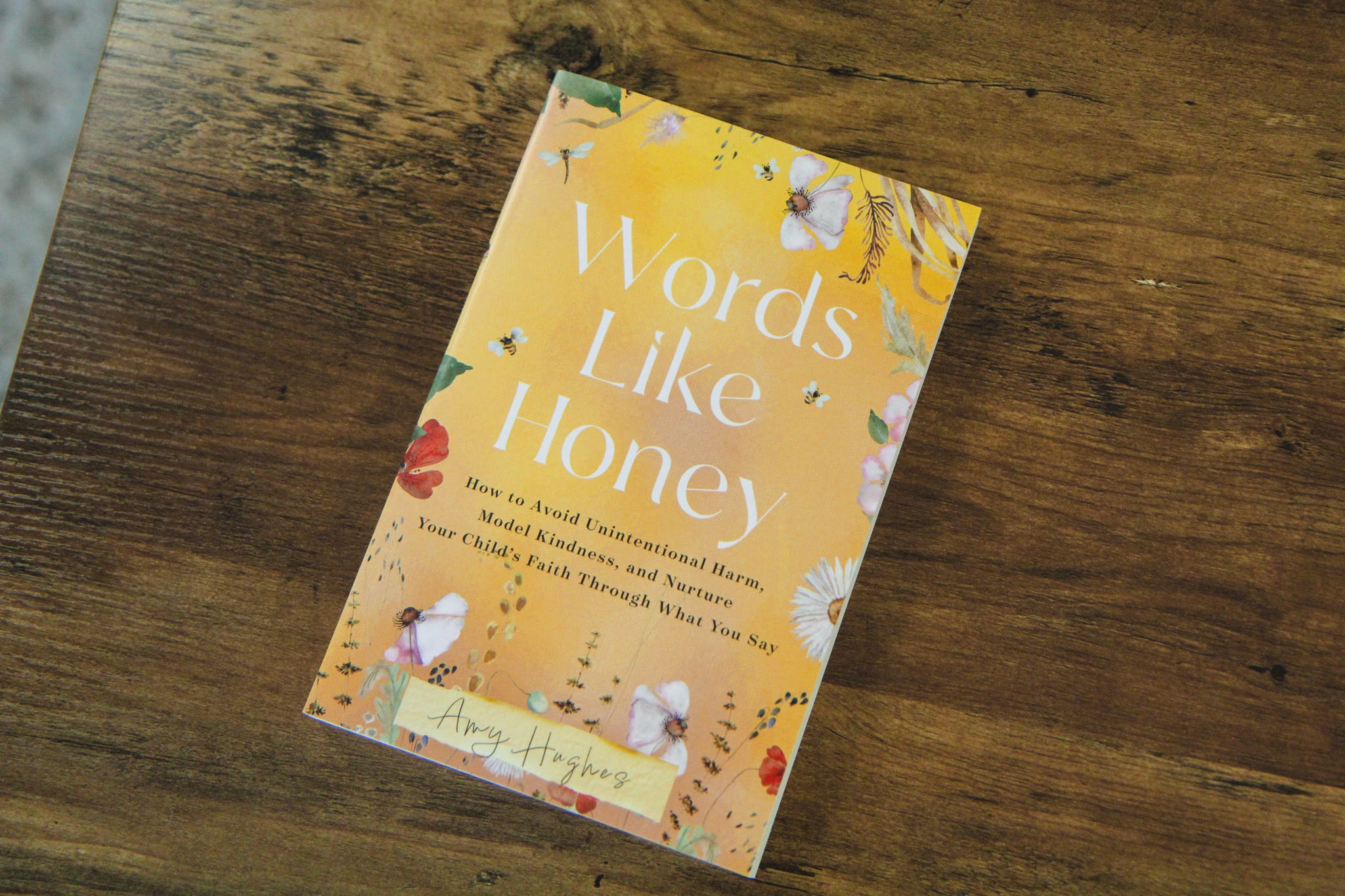
Here’s an excerpt from Words Like Honey to give you a feel for what to expect:
The things that we say to our children matter to their unfolding sense of who they are. With a bit of awareness and intention, we can adjust our language toward health, growth, healing, and encouragement.
At the same time, as Christian parents and caregivers, we have another element to consider— we are not just giving our kids their inner voice and sense of self; we are also laying the foundation for their faith and view of God.
According to the Pew Research Center, nearly 75 percent of young adults raised in the Christian faith fall away after high school. When we are the main examples, mentors, and guides to children, we must acknowledge that the things we say regarding faith and the answers we offer our kids play a large role in creating that statistic.
In Matthew 19:14 Jesus tells us, “Let the little children come to me, and do not hinder them, for the kingdom of heaven belongs to such as these.” As parents and caregivers, we are called to reflect Jesus to the young ones in our care. We are to teach, answer questions, and model Christlike living, compassion, and love.
Yet so often we hinder their budding faith and minimize Jesus by reducing that role to reading our kids some carefully chosen Bible stories, repeating a few common “Christianese” phrases that don’t really reflect the heart of God, praying the same prayers, and shaming any questions that don’t fit in the box.
A study was done at Fuller Theological Seminary over the course of six years that followed five hundred high school graduates during their first few years of college. Among other things, the study concluded the most important factor that determined whether someone left the faith or stayed in it was their ability to express doubts and ask questions about God and Christianity safely and without shame.
Unfortunately, many parents are often afraid of questions and doubts. They avoid them, shame the idea of them, and repeat the Christianese language that perpetuates misunderstandings and irrelevance. Due to this, children often grow up in confusion and have a superficial view of God after childhood. The God they knew as a kid doesn’t fit their young adult life, doesn’t share their concern for diversity and equality, isn’t accepting, and cares more about morals than love, because our language (and often our example) misrepresented him.
Our words have an effect on our children. They either help or hinder their confidence, emotional intelligence, and faith.
Awareness of this fact gives us the ability to speak with intention and purpose, moving away from words that may harm.
In order to transition our speech so that our words help, support, encourage, and build up, it’s essential to become aware of how deeply our words impact our children emotionally, mentally, and spiritually.
We need to know the common phrases that harm and hinder.
We need to know the types of speech that put our kids into fight- or- flight mode.
We need to understand how our children perceive things.
We need to rethink Christian phrases that give children an inaccurate view of God.
At the same time, we also need to learn how to replace terms, how to reframe words and phrases, and how to speak in a way that brings life to our kids’ hearts, minds, and souls.
Amy Hughes, Words Like Honey,
Revell, a division of Baker Publishing Group, © 2025. Used by permission.
Amy Hughes is an author, a conscious Christian parenting coach, a writer and speaker, an Enneagram 4, and queen of awkward silences. She lives a cozy life nestled in the hills near the Pacific Ocean, where she reads too many books, drinks too much chai, and homeschools her still-at-home children.
Drawing from his ancient, St. Thomas Indian Christian roots and a decolonized, justice-centered understanding of Scripture, Joash helps audiences reimagine a faith that unites rather than divides—and that stands firmly with neighbors on the margins. Through speaking engagements, teaching, and advocacy, he calls Christians to a more contemplative yet courageous activism, motivated by the grace-filled, non-violent way of Jesus. To directly support Joash’s upcoming PhD costs (with research focusing on the British Empire’s evangelical missionary interactions with ancient, indigenous St. Thomas Indian Christians), you can upgrade to be a paid Substack subscriber today. We’ve also just launched monthly virtual chai hangouts as an exclusive paid subscriber perk! Thank you for your partnership in this work of awakening the Western Church to prioritize justice through the reimagination of our faith in ancient, Jesus-centered, justice-oriented, and precolonial ways.
The Fuller study statistic about doubts and safe questions being the determining factor for faith retention is huge. I grew up in an environment where questioning felt like betrayal, and it took years to rebuild that part of my spirituality. The idea that we inadvertently hinder faith by reducing it to Christianese and avoiding uncomfortable questoins is something I wish more communities understood. Words really do become the architecture of how kids see both themselves and God.